

ES2B-C001

A HER2-VLP-based active immunotherapy candidate in Phase I clinical development


Overview

Target: HER2 extracellular domain
Modality: HER2-VLP-based active immunotherapy candidate
Development stage: Phase I clinical development

Target population
HER2-expressing cancers, initially HER2-positive breast cancer.

Profile
ES2B-C001 is designed to present HER2 antigens across the extracellular domain using a virus-like particle, or VLP, delivery system. The aim is to stimulate a broad, polyclonal anti-HER2 antibody response targeting multiple extracellular domains of the HER2 receptor.

Development rationale

  • Designed to target multiple HER2 extracellular domains
  • Intended to stimulate a polyclonal antibody response
  • VLP-based format designed for high-density antigen display
  • Potential for use in combination treatment strategies
  • Currently being evaluated in Phase I clinical development

ES2B-C001 is designed to target all four extracellular domains of HER2

By presenting HER2 antigens on a VLP delivery system, ES2B-C001 is intended to stimulate a broad, polyclonal anti-HER2 antibody response.

Status

Why target HER2?

HER2, or human epidermal growth factor receptor 2, is a cell-surface receptor involved in cell growth and signalling. In some cancers, including breast cancer, HER2 is overexpressed or amplified, contributing to tumour growth and disease progression.

HER2-positive breast cancer represents a clinically important subgroup of breast cancer. Although several HER2-targeted therapies are available, treatment resistance and disease recurrence remain important challenges. ES2B-C001 is being developed as a differentiated active immunotherapy approach designed to stimulate a broad antibody response against HER2.

Preclinical data

In preclinical studies, ES2B-C001 was evaluated as a HER2-VLP-based active immunotherapy candidate in mouse models of HER2-positive breast cancer.

The studies reported induction of a polyclonal anti-HER2 antibody response and anti-tumour activity in preclinical models. In vitro, sera from treated animals inhibited growth of HER2-positive breast cancer cells, including cells with reduced sensitivity to trastuzumab.

These findings support the rationale for clinical evaluation of ES2B-C001. They are preclinical results and should not be interpreted as evidence of clinical efficacy in patients.

Clinical trial participation & FAQs

Yes, anyone is eligible to participate regardless of their citizenship and residence, provided they meet the protocol-defined medical eligibility criteria. Participants must cover their own travel and lodging expenses, as these are not reimbursed by the study sponsor.

Please also note that all patient-facing communication and documentation at the clinical site will be in German, so fluency or comfort in German may be required for participation.

Importantly, final enrolment decisions are made by the clinical site. Even if a participant meets the medical criteria, issues related to insurance coverage, cross-border residency, or administrative limitations may result in exclusion. Sites must ensure compliance with local regulations and may choose to decline enrolment to avoid potential legal or financial risks.

ExpreS2ion is not involved in individual screening or administrative decisions and does not have visibility into insurance or residency requirements at the site level.

The trial is currently recruiting at the following clinical site:

Medical University of Vienna
Vienna, Austria, 1090
Contact: Prof. Bernd Jilma
Phone: +43 40400 29800
Email: klin-pharmakologie@meduniwien.ac.at

Further details on the study design, objectives, and contact information can be found on the official ClinicalTrials.gov registry:
https://clinicaltrials.gov/study/NCT06746688

Eligibility is determined according to a detailed set of inclusion and exclusion criteria. Highlights include:

Key inclusion criteria:

  • Age ≥18 years
  • Diagnosis of HER2-positive metastatic or locally advanced inoperable breast cancer
  • ECOG performance status 0–2
  • Adequate organ function and life expectancy of at least 6 months

Key exclusion criteria:

  • Recent or ongoing treatment with certain anticancer therapies
  • Symptomatic CNS metastases or uncontrolled autoimmune conditions
  • Significant cardiac or infectious conditions
  • Pregnancy or lactation in female participants

We strongly encourage reviewing the full eligibility requirements on the study page:
https://clinicaltrials.gov/study/NCT06746688?term=es2b-c001&rank=1#eligibility

Please be aware that ExpreS2ion cannot provide guidance on personal insurance matters, including whether a participant’s private or public insurance will cover aspects of trial participation, care during the study, or unforeseen medical needs.

We recommend that prospective participants consult directly with the clinical site and, if relevant, with their insurer or local healthcare authority. These stakeholders are best positioned to assess how insurance or residency status may impact participation.

The primary focus of the ES2B-C001 Phase I trial is to evaluate safety, tolerability, and to determine the maximum tolerated dose of the active immunotherapy candidate. However, as part of the study’s secondary and exploratory objectives, the trial will also assess immunological responses, including anti-HER2 antibody levels measured using ELISA. In addition, the study will monitor tumour size using radiographic methods (MRI/CT), aiming to potentially capture data on other clinical endpoints such as complete response (CR), partial response (PR), disease control rate (DCR), progression-free survival (PFS), stable disease (SD), disease-free survival (DFS), and overall survival (OS). While these data may offer early insights into biological and clinical activity, the trial is not designed or intended to demonstrate treatment effectiveness. These early observations may help guide the design of future studies.

Interim data will be shared in accordance with clinical and regulatory reporting standards.

Preclinical findings

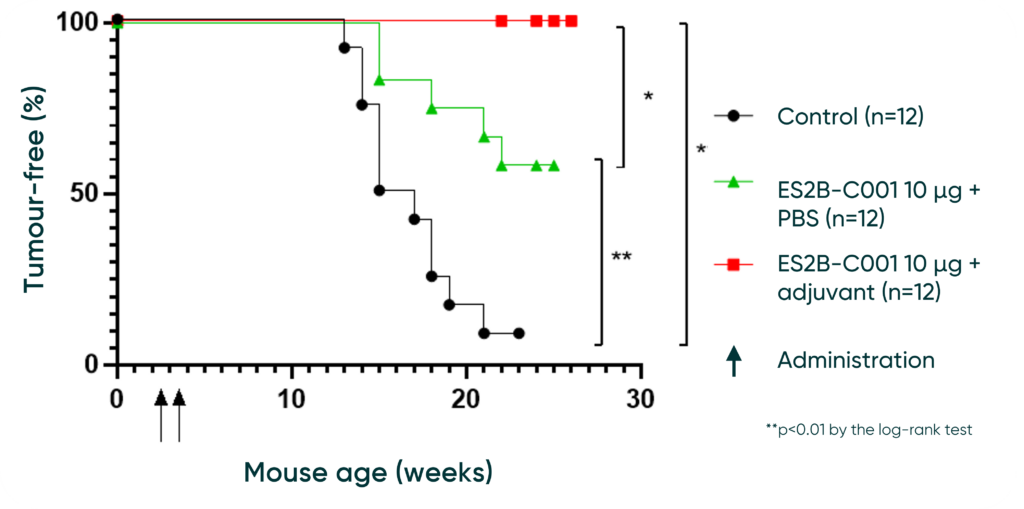
Administration with only two doses of adjuvanted ES2B-C001 completely prevented onset of mammary carcinoma in human HER2 transgenic Delta 16 mice

Kaplan-Meier survival curve demonstrated the efficacy of ES2B-C001 treatments in preventing tumours in mice. Both the ES2B-C001 10 µg and ES2B-C001 10µg + adjuvant groups show a higher percentage of tumour-free mice over time compared to the control group, indicating the potential effectiveness of these treatments (Figure below).

With Adjuvant: Mice receiving 10µg of ES2B-C001 plus adjuvant demonstrate a significantly higher tumour-free survival rate compared to both the control and non-adjuvant groups, maintaining 100% tumour-free status up to nearly 30 weeks of age.

Without Adjuvant: In comparison to the control group, mice injected with 10µg of ES2B-C001 alone show an increased percentage of tumour-free survival up to approximately 22 weeks of age, after which the survival rate declines. This suggests that ES2B-C001 alone can delay tumour development relative to the control.

These conclusions highlight the beneficial effect of the adjuvant in enhancing the anti-tumour efficacy of the ES2B-C001 µg injection. The annotations “*p<0.05” and “**p<0.01” by the log-rank test indicate statistical significance in the differences observed between groups at certain points on the curve. The ***p<0.001 is considered highly significant and implies that the observed results are very unlikely to have occurred by chance.
Source: Studies conducted by Alma Mater Institute on Healthy Planet & DIMES, University of Bologna.

Ref. Ruzzi, et al., Biomedicines 2022, 10, 2654

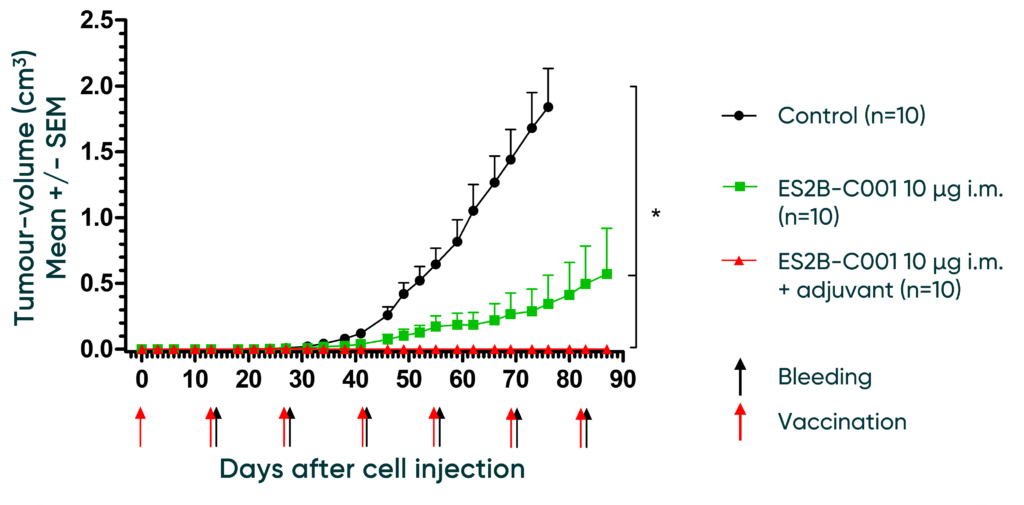
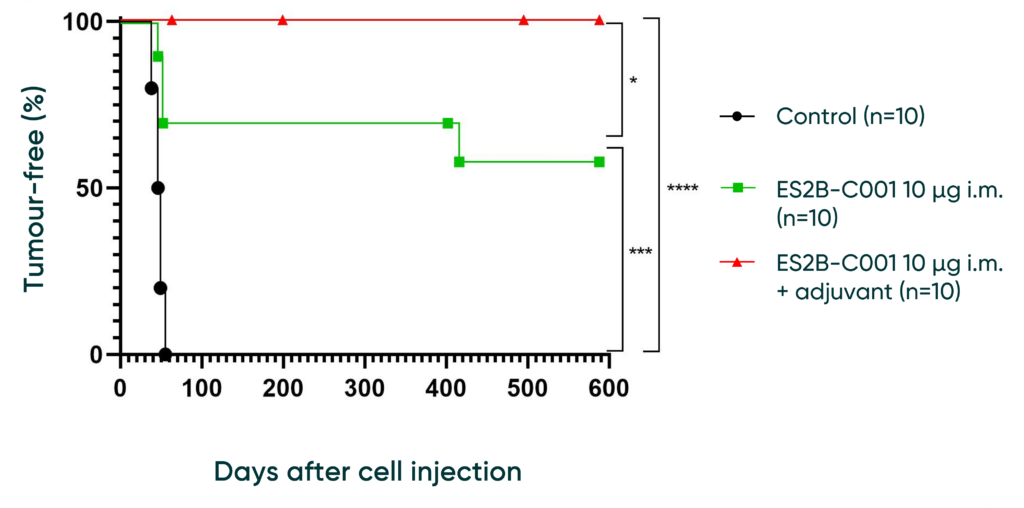
Administration with ES2B-C001 completely inhibited cancer cells growth and resulted in 100% survival until at least 600 days

These conclusions indicate that while the 10 µg of ES2B-C001 by i.m. injection shows some effectiveness in controlling tumour growth compared to the control. The addition of adjuvant significantly enhances this effect.

With Adjuvant: When adjuvant is added to the ES2B-C001 and administered by i.m. injection (represented by the red line with cross markers), the tumour growth rate is completely inhibited compared to the control group. The tumour volumes remain consistently lower than the control group throughout the observed period of 80 days, suggesting a substantial improvement in controlling tumour growth with the addition of adjuvant.

Without Adjuvant: Compared to the control group (represented by the black line with diamond markers), the mice injected with ES2B-C001 (represented by the green line with star markers) show a slower rate of tumour growth, suggesting effectiveness of the ES2B-C001 injection in controlling tumour growth.
With Adjuvant: Mice injected with ES2B-C001 + adjuvant demonstrate a higher efficacy, maintaining 100% tumour-free status throughout the entire duration of observation up to day 600. This significantly outperforms the control group.

Without Adjuvant: Mice injected with ES2B-C001 without adjuvant resulted in 60% tumour-free status.
Source: Studies conducted by Alma Mater Institute on Healthy Planet & DIMES, University of Bologna.
Ref. Ruzzi, et al., Biomedicines 2022, 10, 2654